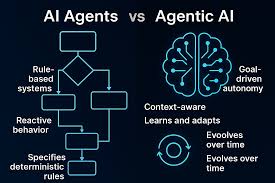
Introduction Agentic AI & Autonomous Systems:
Agentic AI & Autonomous Systems refer to advanced forms of artificial intelligence designed to operate independently, make decisions, and take actions without continuous human intervention. These systems combine Agentic AI, which focuses on intelligent agents capable of reasoning, planning, and goal-directed behavior, with Autonomous Systems, which are engineered to perform tasks in dynamic and complex environments, such as self-driving cars, drones, or robotic assistants. The integration of Agentic AI & Autonomous Systems enables faster decision-making, reduces human workload, and enhances efficiency across industries. However, challenges include ensuring safety, ethical decision-making, and maintaining control over autonomous operations.
what is the interest of new generation on Agentic AI & Autonomous Systems?
Interest of the New Generation in Agentic AI & Autonomous Systems
The new generation is increasingly drawn to Agentic AI & Autonomous Systems because these technologies represent the frontier of intelligent automation and decision-making. With rapid advancements in Artificial Intelligence Agents and Autonomous Systems, young professionals and students are fascinated by systems that can operate independently, learn from experience, and make context-aware decisions.
Key Areas of Interest:
- Autonomous Systems – Young developers and researchers are exploring self-operating vehicles, drones, robotics, and smart infrastructure, driven by the challenge of creating machines that function with minimal human intervention.
- Artificial Intelligence Agents – There’s growing enthusiasm for AI that acts as a personal assistant, virtual advisor, or autonomous software agent capable of interacting, learning, and adapting in complex environments.
- Decision-Making AI – The next generation is particularly interested in AI systems that can reason and make decisions independently, simulating human-like judgment in uncertain or dynamic scenarios.
- Self-Learning Agents & Adaptive AI – The appeal lies in AI that evolves over time, improves performance autonomously, and adapts to new data or environments, allowing users to build intelligent applications without constant human guidance.
- Cognitive Agents & Autonomous Decision Systems – Emerging interest focuses on AI systems capable of understanding, reasoning, and executing high-level tasks, supporting applications in healthcare, finance, and smart cities.
- Why This Appeals to the New Generation:
- Innovation & Creativity: These technologies allow experimentation with futuristic concepts like autonomous vehicles, smart robots, and AI-driven systems.
- Career Potential: Fields like AI-driven robotics, autonomous vehicles, and intelligent agents offer high-demand, well-compensated careers.
- Societal Impact: The ability to solve real-world problems, from climate modeling to autonomous logistics, attracts socially conscious innovators.
- Interdisciplinary Learning: Combines computer science, cognitive science, robotics, and decision theory, appealing to learners seeking broad, impactful knowledge.
- Conclusion:
The new generation sees Agentic AI & Autonomous Systems as both a technological challenge and a career-defining opportunity. With skills in Decision-Making AI, Self-Learning Agents, and Cognitive Agents, they are poised to lead the next wave of intelligent, autonomous innovation.
How can we set our professional career on Agentic AI & Autonomous Systems
Building a Career in Agentic AI & Autonomous Systems
The field of Agentic AI & Autonomous Systems is rapidly expanding, offering diverse career paths for those passionate about intelligent, self-governing technologies. Here’s how you can position yourself professionally:
1. Foundational Knowledge
- Computer Science & AI: Start with core concepts in algorithms, programming (Python, C++, Java), and data structures.
- Artificial Intelligence Agents & Decision-Making AI: Learn about AI agents that perceive, reason, and act autonomously. Online courses and certifications in AI can help.
- Mathematics & Statistics: Master linear algebra, probability, and optimization — essential for building Self-Learning Agents and Adaptive AI models.
2. Specialized Skills
- Autonomous Systems: Focus on robotics, autonomous vehicles, drones, or smart systems. Understanding sensors, actuators, and control systems is key.
- Cognitive Agents: Explore AI that mimics human reasoning, planning, and problem-solving. Knowledge in natural language processing (NLP) and computer vision is advantageous.
- Autonomous Decision Systems: Learn to design systems that can make context-aware, independent decisions with minimal human oversight.
3. Hands-On Experience
- Projects & Internships: Build projects such as autonomous robots, AI decision engines, or adaptive simulation environments. Contribute to open-source AI projects.
- Competitions & Hackathons: Participate in AI/robotics challenges to demonstrate skills in Self-Learning Agents and Adaptive AI.
4. Advanced Education & Research
- Master’s or PhD: Focus on AI, robotics, or autonomous systems. Research in Cognitive Agents or Decision-Making AI can set you apart.
- Publications & Conferences: Present papers in AI and autonomous systems conferences to gain recognition in the field.
5. Professional Networking
- Communities & Forums: Join AI and robotics communities to learn from experts and stay updated on trends.
- Mentorship: Seek mentors experienced in Agentic AI & Autonomous Systems to guide your career growth.
6. Career Opportunities
- Roles: AI Engineer, Robotics Engineer, Autonomous Systems Developer, Cognitive AI Researcher, Decision-Making AI Specialist.
- Industries: Automotive (self-driving cars), aerospace, healthcare, finance (autonomous decision systems), and defense robotics.
Conclusion:
A career in Agentic AI & Autonomous Systems requires a combination of strong technical foundations, hands-on experience with Autonomous Systems, and specialized expertise in Artificial Intelligence Agents, Self-Learning Agents, Adaptive AI, Cognitive Agents, and Autonomous Decision Systems. By continuously learning and experimenting, you can position yourself as a leader in this transformative field.
Explain advantages and disadvantages of Agentic AI & Autonomous Systems:
Advantages of Agentic AI & Autonomous Systems
- Efficiency & Automation
- Autonomous Systems and Artificial Intelligence Agents can perform repetitive or complex tasks faster than humans.
- Reduces human error in industrial, healthcare, and logistics operations.
- Advanced Decision-Making
- Decision-Making AI enables faster and more accurate choices in real-time scenarios, from financial trading to autonomous vehicles.
- Supports Autonomous Decision Systems that can operate in dynamic environments without constant human supervision.
- Continuous Learning & Adaptation
- Self-Learning Agents and Adaptive AI improve performance over time by learning from new data and experiences.
- Enhances system reliability and intelligence without frequent manual updates.
- Cognitive Capabilities
- Cognitive Agents can reason, plan, and solve complex problems, mimicking human-like intelligence.
- Facilitates human-AI collaboration in decision-making, research, and innovation.
- Scalability & 24/7 Operations
- Autonomous Systems can operate continuously without fatigue, scaling services efficiently in industries like logistics, smart cities, and healthcare.
Disadvantages of Agentic AI & Autonomous Systems
- High Development & Maintenance Costs
- Designing sophisticated Artificial Intelligence Agents or Autonomous Systems requires significant investment in hardware, software, and skilled personnel.
- Ethical & Responsibility Challenges
- Decision-Making AI and Autonomous Decision Systems can make critical choices that may have legal or ethical implications, raising accountability concerns.
- Complexity & Reliability Issues
- Self-Learning Agents and Adaptive AI can behave unpredictably in untested scenarios, leading to potential errors or failures.
- Job Displacement Risks
- Automation through Agentic AI & Autonomous Systems can replace human roles in manufacturing, transport, and administrative tasks, creating social and economic challenges.
- Security & Privacy Vulnerabilities
- Cognitive Agents and networked autonomous systems can be targets for hacking, data theft, or misuse, requiring robust cybersecurity measures.
Conclusion:
Agentic AI & Autonomous Systems offer remarkable benefits in efficiency, learning, and intelligent decision-making through Autonomous Systems, Artificial Intelligence Agents, Decision-Making AI, Self-Learning Agents, Adaptive AI, Cognitive Agents, and Autonomous Decision Systems. However, they also come with challenges like ethical dilemmas, high costs, and potential unpredictability. Balancing innovation with responsible implementation is key for sustainable impact.